Chinese translation of Nizami’s “Khamsa” unveiled at 32nd Beijing International Book Fair
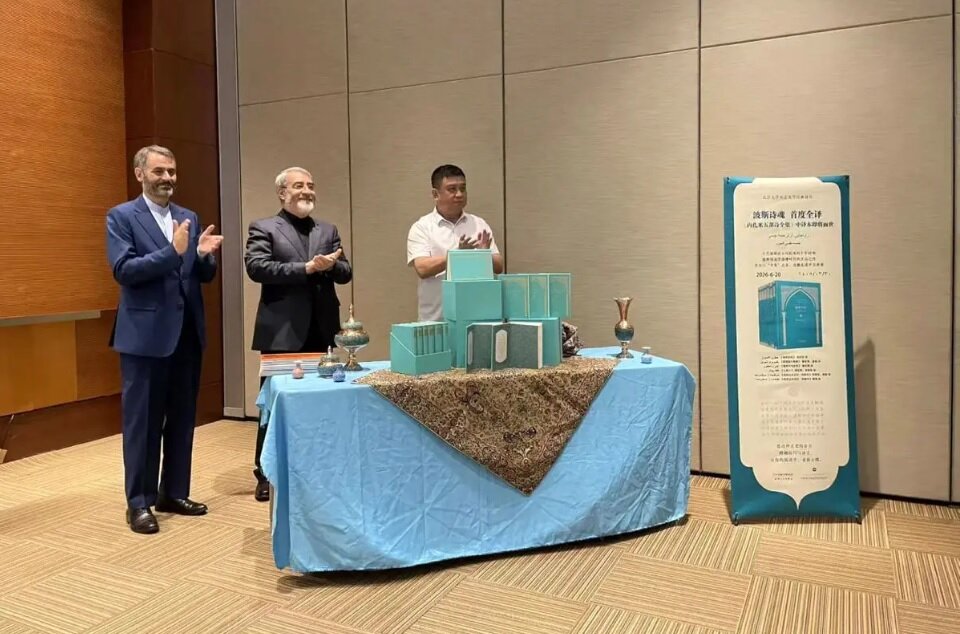
TEHRAN – The complete Chinese translation of “Khamsa” (The Five Treasures), the most renowned work of Nizami Ganjavi, was unveiled on the sidelines of the 32nd Beijing International Book Fair in China.
Through the efforts of the Cultural Office of the Islamic Republic of Iran in China, and following the translation of works such as “Khosrow and Shirin,” “Eskandar Nameh” (The Book of Alexander), and “Makhzan al-Asrar” in 2025, the publication of “Haft Peykar” (The Seven Beauties) and “Layla and Majnun” has now completed the Chinese translation of Nizami’s timeless masterpiece “Khamsa”.
The collection was unveiled during Iran Cultural Day (June 20) at the fair, in the presence of numerous Chinese and Iranian Iranologists, literary figures, professors, and researchers, ILNA reported.
A complete set of the work, bearing a handwritten note and signature from the President of Iran, Masoud Pezeshkian, was presented to the President of the People’s Republic of China, Xi Jinping, while another copy was donated to the Persian Language Section at Peking University.
“In honor of the radiant millennia of civilizational, cultural, and literary exchanges and the inseparable bonds between the land of Iran and ancient China, the gift of Nizami Ganjavi’s “Five Treasures” is presented to the esteemed President of the People’s Republic of China, Mr. Xi Jinping,” President Pezeshkian wrote in his note.
At the unveiling ceremony, Abdolreza Rahmani Fazli, Iran’s Ambassador to China, emphasized the importance and status of Nizami’s “Khamsa” in the history of Persian lyrical and philosophical literature. He voiced hope for the further expansion and deepening of scholarly and literary relations between Iran and China.
“China, one of the largest and most expansive countries in the world, symbolizes greatness and boundlessness in Nizami’s magnificent poetry and serves as a mirror reflecting the power and glory of kings. Throughout the “Khamsa,” in accordance with Persian poetic tradition, references repeatedly appear to the Emperor of China, the beauty of the Chinese people, Khotan musk and Chinese perfume, Chinese bowls and fine porcelain, Chinese Turks, exquisite fabrics and garments such as brocade, silk, robes, and Chinese textiles, as well as other precious gifts from that land—Chinese hats, mats, embroidery, mirrors, painting, carpets, and crowns,” he added.
Rahmani Fazli noted that China also features prominently in several of Nizami’s most captivating stories, including “The City of the Bewildered and the Black-Clad People of China” in “Haft Peykar,” the tale of “Bahram Gur and the Beautiful Chinese Princess in the Sandalwood-Colored Dome,” also known as “The Story of Good and Evil,” and many other narratives. These references, he said, demonstrate the deep and longstanding cultural connections between the ancient civilizations of Iran and China.
Nizami Ganjavi (1141 – 1209) is considered the greatest romantic epic poet in Persian literature, who brought a colloquial and realistic style to the Persian epic. His heritage is widely appreciated in Iran, Afghanistan, the Republic of Azerbaijan, the Kurdistan region, and Tajikistan. The “Khamsa,” which is a collection of five long narrative poems, is Nizami’s main and best-known work.
Photo: Nematollah Iranzadeh, the Cultural Attaché of Iran in China (L) and Abdolreza Rahmani Fazli, Iran’s Ambassador to China (C) attend the unveiling ceremony of the Chinese translation of Nizami’s “Khamsa” at the 32nd Beijing International Book Fair on June 20.
SS/SAB
Leave a Comment